Back to Blog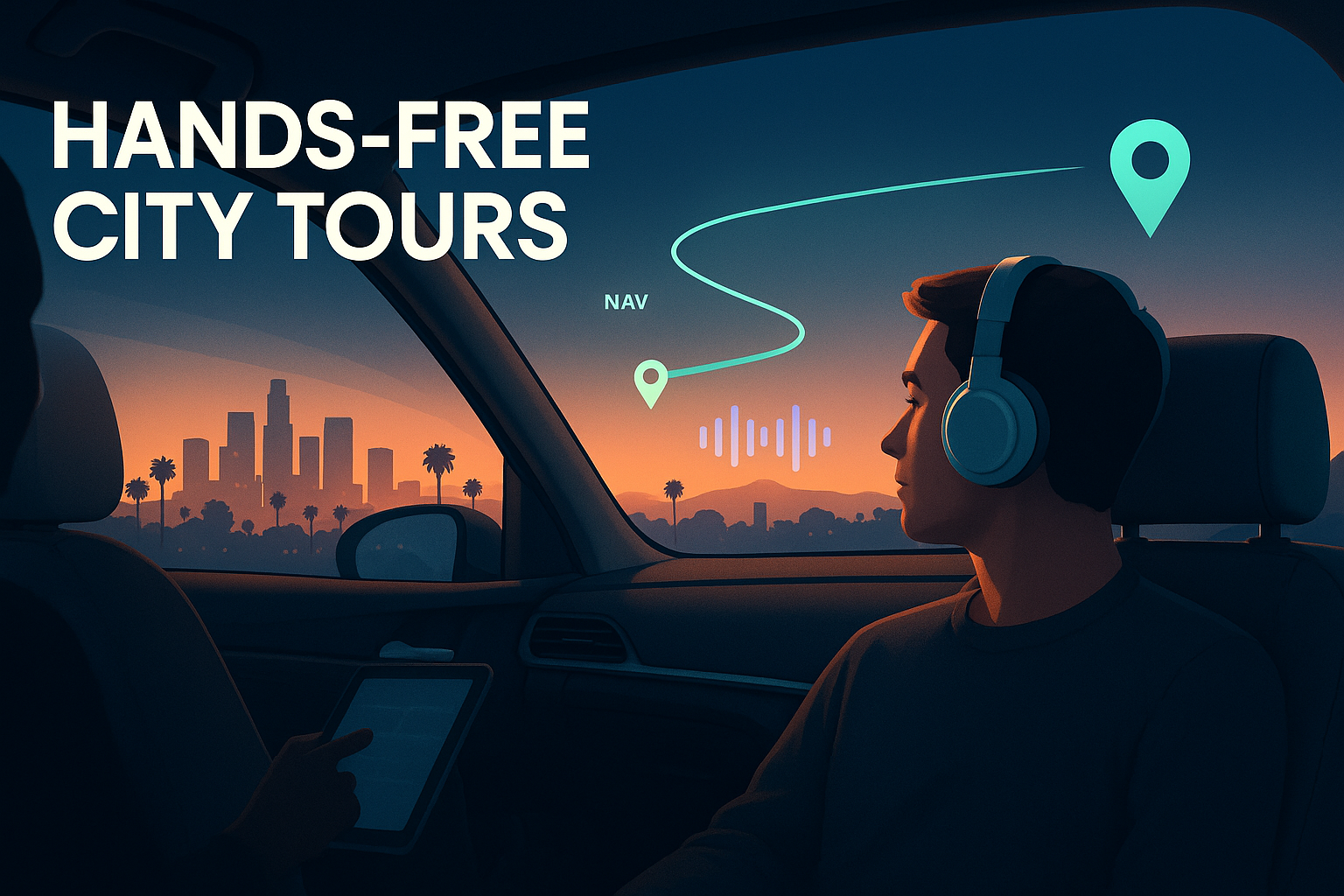
Autonomous Vehicle Tours Los Angeles: How AI Audio Guides Make Self-Driving Sightseeing Feel Personal
BYG Writers•June 24, 2026•5 min read
Planning a day of sightseeing in LA sounds simple until you’re actually in the car: traffic, parking, decision fatigue, and the constant “what are we looking at?” question. That’s why autonomous vehicle tours Los Angeles is becoming a real search term, not just a futuristic idea. The combination of self-driving (or driver-assist) mobility and AI audio narration is meeting a very specific need: hands-free, self-paced discovery that still feels guided.
At the same time, travelers are changing how they plan and experience trips. More people now use AI at some point in their journey, and GPS-triggered audio tours are gaining adoption because they work with the way people actually move through a city. In a place as spread out as Los Angeles, the ability to drive your own route, hear context automatically, and stay present behind the wheel is more than a convenience. It’s quickly becoming the default expectation.
## Why autonomous and AI-audio tours matter in Los Angeles right now
Los Angeles is a perfect storm for this trend: it’s car-centric, geographically vast, and packed with “drive-by” landmarks where the story matters more than the stop. Classic bus tours struggle here. They’re bound to fixed schedules, they can’t easily adapt to traffic, and they tend to turn a personal day into a group event.
Autonomous vehicle tours Los Angeles sits at the intersection of three shifts that are happening at the same time:
1) **Growing comfort with autonomous mobility.** Public sentiment is moving. A Los Angeles survey reported **57% of voters now favor AV passenger services**, a 35-point increase since 2018 (BizFed LA County survey: https://bizfedlacounty.org/press-release/survey-shows-35-point-increase-in-support-for-autonomous-vehicles-in-l-a/?utm_source=openai). That doesn’t mean everyone is ready to jump into a fully driverless car tomorrow. But it does signal that “autonomous” is moving from sci-fi to service category.
2) **Travelers increasingly rely on AI.** Over half of U.S. travelers used AI for at least one trip in the last year (ITIJ: https://www.itij.com/latest/news/ai-use-surges-among-us-travellers-trip-planning-habits-rapidly-shift?utm_source=openai). The practical takeaway isn’t that people want more technology. It’s that they want less friction: fewer apps to juggle, fewer decisions mid-trip, and more helpful guidance.
3) **Audio-first, location-aware experiences fit LA.** LA sightseeing is full of moments you can’t appreciate by looking at a map pin. Why is this street famous? What scene was filmed here? Who lived behind that gate? AI narration, triggered by GPS, is a natural match because it tells the story at the right time, without requiring you to stare at a screen.
For modern travelers, the “tour” is no longer a bus and a microphone. It’s a personalized layer on top of mobility, whether you’re driving yourself, using advanced driver assistance, or eventually riding in an autonomous vehicle.
## A practical breakdown: how to design a hands-free, personalized driving tour experience
If you’re a founder building tourism tech, a tour operator modernizing your offerings, or an IT lead integrating travel experiences into a platform, focus on the end-to-end journey. The win isn’t just “AI narration.” It’s the orchestration of route, safety, context, and trust.
### 1) Start with the real job-to-be-done: “Make LA understandable while I’m driving”
Most people don’t want an encyclopedic lecture. They want:
- A clear route (with optional detours)
- A calm, confident narrator
- Stories timed to what they can actually see
- Minimal taps while moving
- Flexibility to pause, skip, or reroute
This is where an **AI narrated self guided driving tour LA** experience earns its keep. The best versions behave like a great local friend: brief when traffic is intense, richer when you’re cruising, and always aware of where you are.
### 2) Choose a tour format that matches LA behavior
In LA, different travelers want different “day shapes.” Offer multiple formats:
- **Loop tours (2–4 hours):** Hollywood to Beverly Hills to Sunset Strip and back.
- **Point-to-point tours:** Santa Monica to Malibu, Downtown to Griffith Park.
- **Neighborhood deep dives:** Studio City, Silver Lake, Culver City, Arts District.
- **Theme tours:** film locations, celebrity homes, murals, architecture, food history.
Your AI narrated self guided driving tour LA should support “pause-and-resume” behavior because people will stop for coffee, photos, or traffic.
### 3) Make narration contextual, not constant
One of the easiest ways to ruin an audio tour is over-narration. Treat narration like a navigation assistant, not a podcast.
Practical rules that work:
- **Use short segments (20–60 seconds)** near key waypoints.
- **Add optional deep dives** when the user taps “tell me more.”
- **Avoid instructions that compete with driving.** Keep the primary screen simple and voice-driven.
- **Handle “missed” landmarks gracefully.** LA roads are chaotic; people will take the wrong turn.
In an autonomous vehicle tours Los Angeles scenario, this gets even better: if the passenger is not actively driving, you can offer richer storytelling, trivia, and interactive prompts without compromising safety.
### 4) Build trust with clear safety and autonomy messaging
“Autonomous” means different things to different people. Some think it’s a robotaxi with no steering wheel. Others think it’s lane-keeping plus adaptive cruise control.
If you’re offering autonomous vehicle tours Los Angeles (or anything that uses autonomous fleets), be precise:
- Define the autonomy level in plain language.
- Explain where the vehicle can operate (geofenced areas, expected conditions).
- Provide clear behavior expectations (seatbelts, no standing, no interfering with controls).
- Share what happens if something unexpected occurs (remote support, safe stop, reroute).
Even for non-driverless experiences, address safety:
- Encourage hands-free use (voice controls, auto-play).
- Include a “passenger mode” where a co-rider can control the experience.
### 5) Personalize the tour without creeping people out
Personalization is valuable when it’s transparent and user-controlled. The simplest, effective model:
- Ask what they’re interested in (movies, architecture, celebrity history, nature).
- Ask time budget and start point.
- Ask language preference.
- Ask tolerance for traffic and hills.
Then generate:
- A recommended route with alternates
- A narrative style (short, standard, deep)
- Optional stops that match interests
An **AI narrated self guided driving tour LA** can do this with a lightweight onboarding flow. Avoid requesting unnecessary personal data. Keep it “preferences,” not “profiling.”
### 6) Design for offline and spotty connectivity
LA has dead zones, and roaming travelers often have limited data. Your experience should degrade gracefully:
- Offline map tiles for the route
- Pre-downloaded audio packs for key neighborhoods
- Lightweight fallback narration when GPS accuracy drops
If the user can’t trust that the tour works everywhere, they won’t rely on it while driving.
### 7) Add multilingual support the right way
Multilingual is not just translation. It’s pacing, local references, and pronunciation. Minimum viable approach:
- Start with 3–5 high-demand languages.
- Use voice options that sound natural, not robotic.
- Localize measurements, slang, and cultural references.
For autonomous vehicle tours Los Angeles targeting international travelers, multilingual narration is often the difference between “cool idea” and “we’ll actually book this.”
### 8) Keep the experience “self-paced,” not “self-managed”
Self-guided shouldn’t mean the user becomes the tour operator. Give them confident defaults:
- Suggested start times (to avoid peak traffic)
- Parking hints where it matters
- “If you only have 90 minutes, do this” shortcuts
- Detours when traffic is heavy
This is where AI is genuinely useful: not to impress people, but to reduce micro-decisions.
### 9) Measure what matters (and avoid vanity metrics)
If you’re building or operating these tours, track:
- Route completion rate (did they finish?)
- Skips per segment (are you talking too much?)
- Reroutes and recovery success (did the tour adapt?)
- Language usage, offline usage
- Safety-related prompts (are people interacting while driving?)
Good autonomous vehicle tours Los Angeles products will look boring in analytics at first: fewer taps, less screen time. That’s a feature.
## Tools, platforms, and real use cases (including BYG TOURS AI)
The ecosystem for AI-audio and location-based tours is getting more practical. You don’t need a custom app from scratch to test demand, but you do need to think through orchestration.
### Common building blocks for AI-audio driving tours
- **GPS-triggered audio playback:** Automatically start/stop narration based on location. This is the backbone of an AI narrated self guided driving tour LA.
- **Route optimization:** Offer alternates and time-based suggestions (morning vs afternoon traffic patterns).
- **Content pipeline:** A system for researching, writing, fact-checking, and updating stories. LA changes fast.
- **Voice layer:** Text-to-speech voices that are natural and consistent, with the ability to swap languages.
- **Analytics and feedback:** Lightweight prompts like “Was this interesting?” after a segment.
### Use case 1: Celebrity homes and film-location routes without a group bus
People want the Hollywood story, but they don’t always want a bus schedule or a crowded van. A self-paced tour can:
- Navigate around time-sensitive congestion
- Offer “drive-by” context without requiring stops
- Provide optional deep dives for film fans
This is where autonomous vehicle tours Los Angeles could evolve: a passenger experience inside an AV where the tour is the primary entertainment layer.
### Use case 2: Sustainable, tech-forward LA experiences (EV and AV aligned)
Many travelers specifically want an experience that feels modern and responsible: EV rides, reduced idling, planned routes that avoid wasteful backtracking. An AI narrated self guided driving tour LA can incorporate:
- Efficient routing
- Charging stop suggestions (if relevant)
- Neighborhood guidance that avoids unnecessary circling
### Use case 3: Multilingual tours for international visitors
LA draws global tourism year-round. A multilingual audio layer reduces friction immediately:
- Fewer misunderstandings
- Less dependence on guides or printed materials
- A more inclusive experience for mixed-language groups
### Where BYG TOURS AI fits (practical, not salesy)
If you’re trying to deliver location-aware storytelling without building everything from scratch, **BYG TOURS AI** is positioned for exactly this kind of experience: guided content that can be automated, personalized, and delivered in a way that respects the realities of being on the road.
A few ways teams typically use BYG TOURS AI:
- **Rapid prototyping:** Test a new LA route and narration style before investing in custom development.
- **Content consistency:** Keep stories updated and structured, so the experience doesn’t depend on a single writer’s docs.
- **Personalization controls:** Offer different tour “modes” based on interest and time.
For related ideas on building modern, app-based tour experiences, you can also explore BYG TOURS AI’s broader perspective on self-guided travel at https://WelcometoLA.app.
### A note on autonomy: align tour UX with vehicle capabilities
If you’re integrating with autonomous fleets now or later, design the tour layer to be flexible:
- Driver mode: minimal interactions, short narration
- Passenger mode: richer stories, quizzes, “look left/right” prompts
- Fully autonomous ride mode: optional interactive chapters, curated playlists, accessibility features
That’s how autonomous vehicle tours Los Angeles becomes a durable product category rather than a one-off novelty.
## Conclusion and CTA
Los Angeles is built for driving, but not always built for understanding. That gap is what’s pushing demand for autonomous vehicle tours Los Angeles and for AI-audio experiences that make self-driving sightseeing feel guided without feeling constrained. When the narration is GPS-aware, the route is flexible, and the interface is truly hands-free, travelers get what they actually want: freedom plus context.
If you’re evaluating an **AI narrated self guided driving tour LA** concept, focus on the fundamentals: trust, safety-forward UX, offline resilience, and personalization that’s clearly opt-in. Then test routes and content the same way you’d test any product: small pilots, real feedback, quick iteration.
If you're exploring this for your team, BYG TOURS AI can help. Need help connecting your systems or mapping a pilot route across LA neighborhoods? Let’s talk. Want to automate this process and get a working prototype in weeks instead of months? Book a free consult.
Ready to explore LA?
Book one of our premium tours and experience the city like never before
Explore Tours