Back to Blog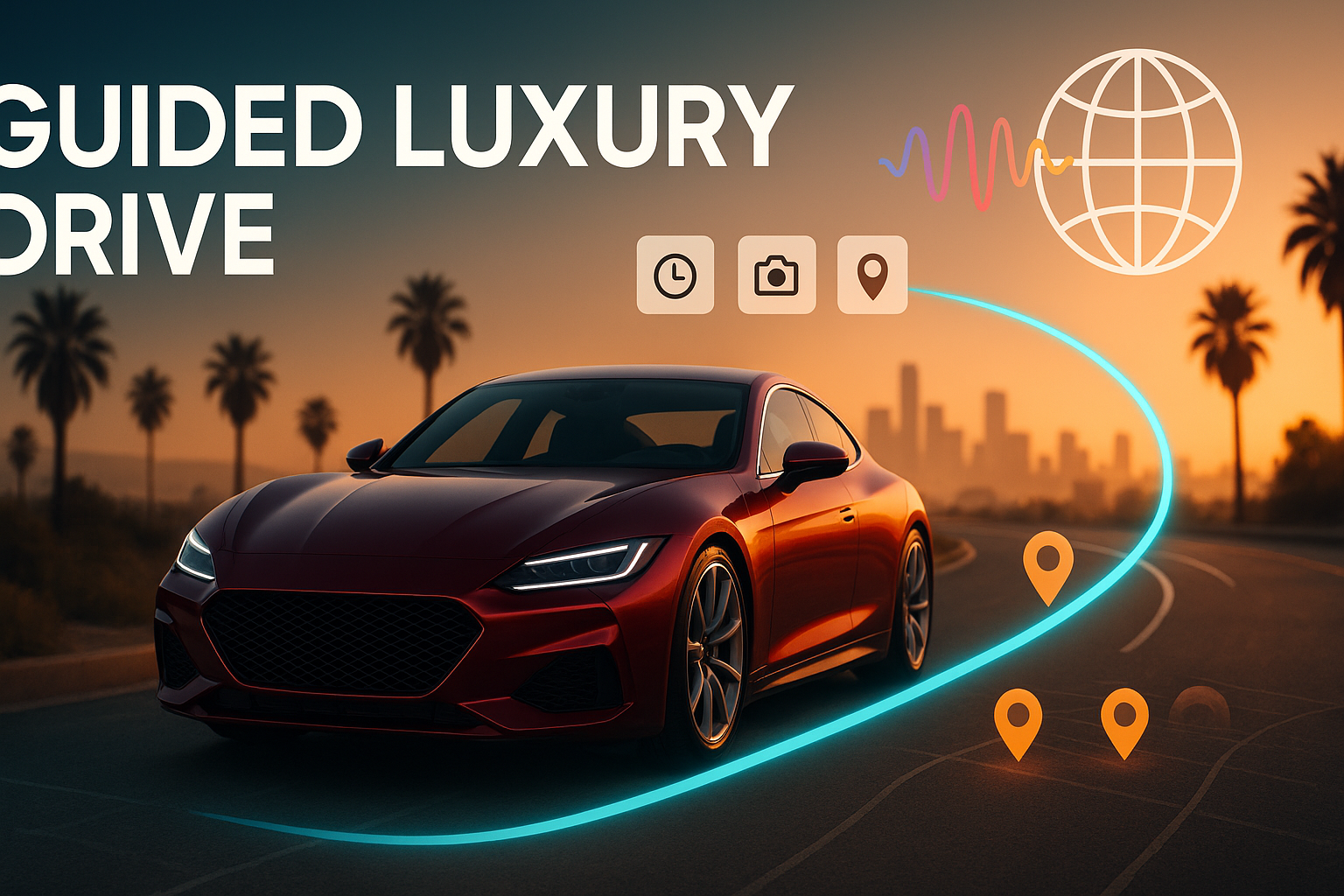
LA AI Guided Supercar Tour: How Trip Planning and Multilingual Voice Guides Are Redefining Self-Guided Drives
BYG Writers•June 28, 2026•5 min read
The idea of a supercar tour in Los Angeles used to come with tradeoffs: you either followed a convoy on someone else’s schedule, or you drove solo and missed the context that makes LA special. That’s changing fast. A LA AI guided supercar tour blends AI trip planning with multilingual, voice-enabled guidance so you can drive at your own pace without losing the story, the safety guardrails, or the “what should I do next?” support.
This matters right now because traveler expectations have shifted. More people are comfortable letting digital assistants plan routes, recommend stops, and narrate experiences in real time. At the same time, Los Angeles is becoming a showcase city for autonomous mobility and AI-assisted navigation, which raises the bar for what visitors consider “normal.” If you’re running tours, hospitality, or experience ops, this is one of those moments where the product definition is moving under your feet.
Why AI-guided supercar tours matter for modern LA travel
Self-guided tours are not a niche anymore. Travelers want control of the clock, fewer awkward group constraints, and the ability to adapt to traffic, weather, and energy levels. The friction has always been guidance: where to go, what to skip, how to stay safe, and how to understand what you’re seeing.
Recent survey data shows how quickly behavior is shifting. Over 56% of U.S. leisure travelers used AI tools to plan trips in the past year, up from 24% in 2024, and many now prefer AI or digital assistants to human guides on location (56% vs 37%). Demand is especially strong for multilingual voice narration, AR-style modes, and offline capabilities. Source: https://www.alpn.ai/blog/ai-trip-planning-changing-travelers-find-tours-heres-data/?utm_source=openai
In Los Angeles, this intersects with something else: growing acceptance of autonomous mobility as part of daily life. Waymo’s service expansion and partnerships like MOIA/Uber signal a future where “autonomous” and “guided by software” are not exotic. Even if today’s supercar tours are driven by the guest, the expectation is the same: the experience should feel intelligently assisted.
For premium experiences like supercar rentals and curated drives, the stakes are higher:
- Language barriers cost you repeat business. If a guest can’t fully understand the route guidance, rules, or cultural context, they’re stressed instead of immersed.
- LA is complex to navigate. Between freeway interchanges, canyon roads, and dense neighborhoods, “just follow Google Maps” is rarely enough for a luxury experience.
- Traditional tours are inflexible. Fixed times and fixed routes don’t match how people actually travel (late breakfasts, last-minute reservations, traffic surprises).
- Safety and liability require consistent guidance. Human guides vary. Software can enforce consistent reminders, speed and hazard warnings, and “don’t stop here” guardrails.
- Connectivity is unreliable in canyons or hills. If your product assumes perfect mobile data, you’re inviting a bad day.
A LA AI guided supercar tour solves these by combining route intelligence, context, and on-the-fly personalization. Done well, it doesn’t replace a host’s hospitality, it replaces the avoidable friction that makes guests feel rushed or lost.
How AI trip planning + multilingual voice guidance actually works (practical breakdown)
The best way to think about this is as three layers working together: planning, guiding, and adapting.
1) Start with a trip plan that’s built for supercars, not generic sightseeing
Most trip planners optimize for “fastest route” or “most popular stops.” A supercar tour has different constraints:
- Road quality matters (potholes, narrow lanes, steep driveways)
- Traffic patterns matter (Sunset vs Mulholland at different hours)
- Stop design matters (safe pull-outs, valet-friendly venues, photo angles)
- Sound and driving feel matter (sweeping roads vs gridlock)
An AI trip planner should ask the right intake questions and then generate an itinerary that matches driving intent:
- Your time window (2 hours vs 6 hours)
- Your comfort level with canyon roads
- Your priorities (ocean views, skyline shots, celebrity neighborhoods, architecture)
- Your passenger needs (kids, mobility constraints, motion sensitivity)
- Your language preference
Practical tactic: build “route archetypes” and let AI customize within guardrails. Examples:
- Sunset-to-coast: Hollywood overlooks → Santa Monica → Malibu pullout
- Canyons and views: Studio City → Mulholland overlooks → canyon loop → back
- Iconic LA loop: Griffith Park viewpoints → Hollywood sign angles → Rodeo Drive photo stop
If you run an autonomous supercar tour Los Angeles concept or a driver-led one, this planning step is where you protect the brand. Don’t allow AI to “invent” unsafe turns or stops. Constrain it to approved roads and approved parking options.
2) Convert the plan into a voice-first guide that doesn’t distract the driver
A premium self-guided drive needs narration that feels like a calm co-pilot, not a podcast you have to manage.
Key design requirements for multilingual voice guides:
- Short prompts timed to driving context (before turns, before merges, before viewpoints)
- Clear “what to do next” instructions, separate from story narration
- Driver-safe pacing with fewer interruptions on complex roads
- A fallback mode when GPS drifts or data drops
A simple structure works well:
- Safety cue: “Curves ahead. Keep right, no stopping.”
- Navigation cue: “Next right in 0.3 miles.”
- Context cue: “This ridge line is part of the Santa Monica Mountains…”
This is also where multilingual support stops being a checkbox and becomes real product value. Translating the words isn’t enough. You need:
- Localized place names and pronunciation
- Cultural context that makes sense in the guest’s language
- Units (miles vs kilometers) aligned to user preference
- Emergency and rule reminders that are unambiguous
If your team is exploring an autonomous supercar tour Los Angeles offering in the future, voice guidance becomes even more important for trust. People accept autonomy faster when the system explains what it’s doing and what to expect next.
3) Use “dynamic routing” so traffic doesn’t ruin the experience
LA traffic is not just inconvenient, it can destroy the emotional arc of a luxury drive. Dynamic routing means your system can adjust the plan while preserving the vibe:
- If PCH is jammed, offer a canyon alternative that still delivers views.
- If a photo stop is full, suggest a nearby turnout with safe parking.
- If a guest is running late, compress the route without skipping the best moment.
This is where AI helps beyond standard navigation. It can re-score route options based on your experience goals, not just time saved.
Practical tactic: define “experience priorities” as rules.
- Must include at least one skyline overlook
- Avoid narrow residential roads after 8 pm
- No stops requiring parallel parking
- Keep total “stop time” under 25% of the drive for short tours
Then let the system adapt within those rules.
4) Build in offline resilience (because canyons happen)
If you’re delivering a LA AI guided supercar tour, assume the guest will hit weak reception at the worst time. Offline capability doesn’t need to mean “everything works perfectly,” but it should cover the essentials:
- Route cached in advance
- Turn-by-turn cues from stored map data where possible
- A “return to base” option that works with low data
- Emergency instructions and contact options accessible without a web page
Practical tactic: pre-download route tiles and narration packs when the guest checks in or starts the tour.
5) Make personalization feel like a concierge, not an algorithm
Personalization is valuable when it’s specific and respectful of time:
- “Want a 10-minute coffee stop with easy parking?”
- “Prefer more driving and fewer stops?”
- “Do you want the next viewpoint now, or after sunset?”
Avoid personalization that feels creepy or random. Keep it tied to tour goals and clear user choices.
6) Add guardrails for safety, legality, and brand protection
Self-guided does not mean ungoverned. AI should be used to enforce consistent policies:
- Remind guests about speed limits in residential areas
- Warn against illegal pullovers or stopping on blind curves
- Flag zones where noise complaints are common
- Provide clear “no filming while driving” reminders
If you’re building toward an autonomous supercar tour Los Angeles roadmap, these guardrails become a foundation for responsible operations.
7) Design the “moments,” not just the route
The difference between a route and a tour is intentional moments:
- A safe pullout with a specific camera angle recommendation
- A short story tied to what the guest can see right then
- A prompt to switch to a quieter narration mode during complex driving
AI makes this scalable. You can keep a consistent brand voice while varying details for time of day, language, and guest interests.
Tools, platforms, and real use cases (including BYG TOURS AI)
You don’t need a futuristic car to deliver a modern guided experience. You need a stack that combines content, navigation logic, and voice delivery.
1) BYG TOURS AI for AI-assisted self-guided experiences
If you’re creating a LA AI guided supercar tour experience, BYG TOURS AI is useful as a practical foundation for building self-guided routes with narration and on-the-go guidance. The goal is not to “replace humans,” it’s to make the experience reliable when the guest is driving, choosing stops, and switching languages.
Common use cases where BYG TOURS AI fits well:
- Multilingual voice narration so guests can choose their language without needing a separate guide
- Route-based storytelling that triggers at the right location instead of forcing guests to read while driving
- Easily updating tour content when LA venues change, roads close, or new viewpoints become popular
If you want a reference point for how AI-driven tours can be structured, see related examples and updates on https://WelcometoLA.app.
2) Navigation and mapping: don’t fight the ecosystem, integrate it
Even if your experience is AI-guided, guests still trust familiar navigation UIs. Consider:
- Apple Maps / Google Maps handoff for turn-by-turn, with your voice guide layered for context
- Prebuilt waypoints and safe stops shared via deep links
- Geofenced triggers for narration to avoid constant manual tapping
Operational note: map links alone don’t create a tour. They create a route. Your differentiation comes from curation, safety logic, and voice experience.
3) Translation and voice: quality matters more than feature count
For multilingual guidance, prioritize clarity over novelty:
- High-quality text-to-speech voices with consistent pacing
- Proper noun handling (Hollywood, Mulholland, Rodeo Drive)
- A way to review translations with native speakers for your top languages
4) AR and “heads-up” modes (use carefully)
Travelers say they want AR. Drivers should not be asked to look at overlays. Where AR can work:
- Passenger mode only
- Parked-only moments at viewpoints
- Photo framing guides when stopped
If you support an autonomous supercar tour Los Angeles concept later, AR becomes more plausible, but today the safest approach is a parked-only rule.
5) Practical operator workflows (what to implement first)
If you’re a tour operator or experience designer, a sensible rollout order is:
- Approved routes + approved stop list (safety and quality)
- Multilingual voice narration for the top 3 to 5 guest languages
- Offline caching and a clear recovery path
- Dynamic reroute rules based on traffic and time window
- Optional passenger-mode enhancements (AR, deeper stories)
This staged approach keeps you from overbuilding while still delivering a clear upgrade over traditional tours.
Conclusion: what to take away and what to do next
A LA AI guided supercar tour is not just a trendy add-on. It’s a response to how travelers now plan and experience cities: they want personalization, language accessibility, and guidance that adapts in real time without forcing them into a rigid group schedule. In Los Angeles, where navigation complexity and traffic can make or break a premium drive, AI trip planning plus multilingual voice guides is the difference between “cool car” and a polished, low-stress experience.
If you’re designing or modernizing a tour, focus on the fundamentals: curated routes built for supercars, driver-safe voice guidance, offline resilience, and clear safety guardrails. Then layer in personalization that feels like a concierge, not an algorithm.
If you’re exploring this for your team, BYG TOURS AI can help you build and maintain a self-guided experience with multilingual narration and location-based guidance. Need help connecting your systems or defining the right route guardrails? Let’s talk. Want to automate this process? Book a free consult.
Ready to explore LA?
Book one of our premium tours and experience the city like never before
Explore Tours